
You may have looked in the mirror and had the thought – I wish I had better posture, or seen a friend and been jealous of how effortless they look when they’re sitting or standing. You may have even taken this a step further and looked for devices or exercise routines that claim to improve one’s posture. I, for example, see a persistent ad on Instagram that advertises a posture corrector endorsed by Taylor Swift. In a marketplace filled with influencers hawking fitness culture and posture correctors and an FDA which does not regulate or refute any of these claims – it might be wise to think a little critically.
Before we can say what is good posture – you may want to consider the picture below:
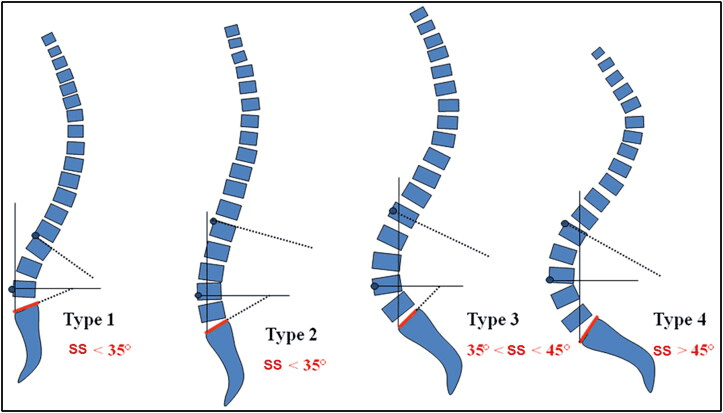
That’s too much information, Jenna, you might be thinking, what is this even a picture of?
Above is the Roussouly system of classification for spinal types used by medical professionals. I didn’t even learn about it in PT school. It depicts normal spinal types that occur in the general population. A spinal type refers to the ratio of curvature present in the cervical spine (neck), thoracic spine (upper back or every vertebrae that connects with a rib), lumbar spine (low back), and sacrum. The Roussouly system of classification highlights four main spinal types (illustrating sagittal alignment of the spine – the view of a person from the side, not the front or back). Roussouly was the first to consider what are spinal types in an asymptomatic context. In terms of how common each spinal type is, type 3 is the most common (47% of the population studied), 2 and 4 are about equal (2 is 23%, 4 is 25%) and 1 the least (5%). There are limitations to this classification – spinal types were only studied in individuals who were asymptomatic (meaning it excluded individuals with back and neck pain), were young (average age 27 years old), and exclusively caucasian. Despite its limitations, this classification remains in use by spinal surgeons and medical experts in back pain worldwide. This information is presented not to overwhelm you, but to give context to the idea that “good posture” can look different on different individuals.
Generally speaking, good posture refers to a head that is centered over the pelvis, above two equally distant feet, not leaning excessively forwards or backwards or sideways. Personally, based on my personal and professional experience, I would take it a step further and say good posture relies on a dynamic system of muscles that work in concert with the skeleton – one in which the more vertically oriented muscles (like the rectus abdominus, the iliopsoas, or the erector spinae group) do not overwork for the more horizontally oriented postural muscles – like the spinal intrinsics and the transverse abdominis. Now this is becoming too much information – and also, why if you have back pain, it might be worth it to get an assessment…